
// Cybersecurity · for Düsseldorf & the Rhine-Ruhr region
Cybersecurity for businesses
Very few attacks go looking for a particular company. They go looking for an open door. We close those doors — and agree beforehand what happens if one of them was open after all.
// Threat picture
Why mid-sized companies get hit
Who gets hit next is rarely decided by a person. Automated sweeps work through whole address ranges without pause and write down where a login sits without a second factor, where a service is exposed to the internet by accident, and where a piece of software has not seen an update in months.
Only afterwards does someone look at what lies behind the open door. A mid-sized company is no less attractive than a corporation in that view: what it lacks in size it makes up for in weaker resistance, because it is rare to find anyone here whose only job is security.
So we do not start with a product. We start with an inventory: which doors does your business actually have — accounts, end devices, network, data, and the people who work with all of it every day? Only once that list exists is it worth arguing about technology.

// What an incident sets off
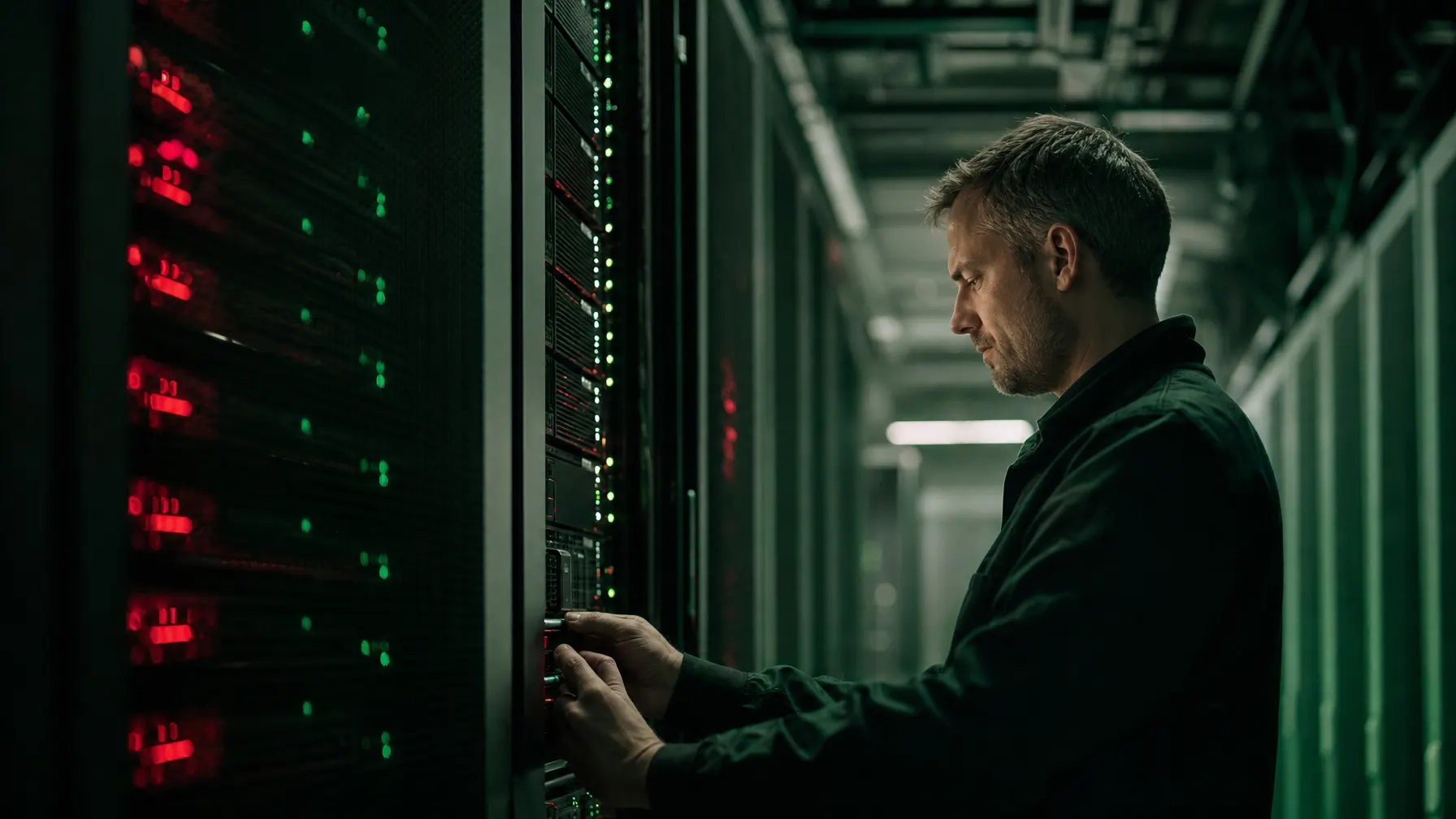
The expensive part is not the encrypted file, it is the week that follows.
A serious incident rarely stops at IT. Order intake is down, delivery notes cannot be printed, and in parallel a statutory reporting deadline is running, for which somebody has to supply defensible facts — ideally not from memory.
Backup and recoveryProduction, dispatch and invoicing all hang off the same systems.
Those affected and the regulator expect to be told which data left the building.
Customers and suppliers ask questions before they place the next order.
Without a tested backup, recovery turns into rebuilding from scratch.
// Layers of protection
No single measure carries the weight
Every individual hurdle can be stepped over. So we stack them in a way that one mistake in one place does not open the whole house at once.
Network security
Separated zones make sure an infected machine cannot reach everywhere at once.
Endpoint security
Laptops, desktops and mobiles set up the same way, kept current and encrypted.
Firewall and VPN
A controlled edge outwards and remote access that does not drag half the network along.
Monitoring and response
Unusual activity gets noticed, and an agreed procedure is ready if it turns serious.
Backup and recovery
The route back into business, restored regularly instead of merely configured once.
Operations and support
So hardening does not decay as soon as devices, accounts and software change.
// Order of work
From current state to protection that holds
Security rarely fails on willingness. It fails on sequence. We begin where risk drops fastest.
What can be reached?
We record accounts, devices, services facing outwards and data stores — including the ones that only still run out of habit and no longer belong to anybody.
What comes first?
Findings are ordered by potential damage and by effort. Some of it is done in an afternoon; the rest belongs in the annual plan.
Harden without stopping work
Accounts, end devices and network are brought up to standard in agreed windows. Anything people will notice in daily work is announced beforehand.
Stay with it
Monitoring, updates and recurring reviews carry on. Being secured is a state, not a result you file away.
// Worst case
The awkward questions belong answered in advance
-
Who decides?
Shutting systems down or letting them run is a business call, not a technical one. The name behind it is better fixed beforehand.
-
Who can be reached?
When mail and the phone system are affected, a contact list that lives outside your own systems is what saves the evening.
-
What has to be reported?
A statutory notification needs timing, scope and the data involved — logged as it happened rather than reconstructed later.
-
What do we start up first?
An agreed order for the systems the business cannot run without spares you the longest argument on the day itself.
// Questions about cybersecurity
What company directors ask us first
01 Is anti-virus software on every machine enough?
It belongs in the picture, but it will not carry the load alone. Most serious incidents do not start with a malicious file — they start with a valid login in the wrong hands. No scanner catches that. A second factor does, and so does a network that is not equally open everywhere.
02 We are too small to be a target. Is that true?
That assumption costs money with some regularity. First contact is nearly always automated, and it does not ask what industry you are in. It asks whether something reachable is unpatched. Selection happens afterwards, and what counts then is how little resistance is expected.
03 What good is security if staff click on everything anyway?
That is exactly why we plan for the click. The technical side has to survive it: separated network zones, restricted rights, and a backup that a hijacked account cannot reach. Training helps on top of that, but as the only line of defense it is far too unreliable.
04 Do we have to rebuild everything at once?
No, and we advise against it. We sort by effect: accounts and backups come first, because that is where the biggest risk drops for the smallest effort. Larger work on the network or on end devices follows in steps your operation can absorb.
05 Can you take over security on an ongoing basis?
Yes. One-off hardening decays the moment devices, accounts and software change. Under a support agreement, updates, permissions and monitoring stay with us, and you get a named contact instead of a project number.
06 What happens in the first conversation?
We look at which of your systems can be reached from outside, how end devices are managed, where data actually sits and whether a restore has ever been rehearsed. Out of that comes a list ordered by urgency — with no product quote on day one.
Go deeper
Read the cybersecurity checklist
When did you last check what can be reached from outside?
If the answer is older than a year, it is worth a look. We check, sort the findings by urgency and say plainly which of them can wait.